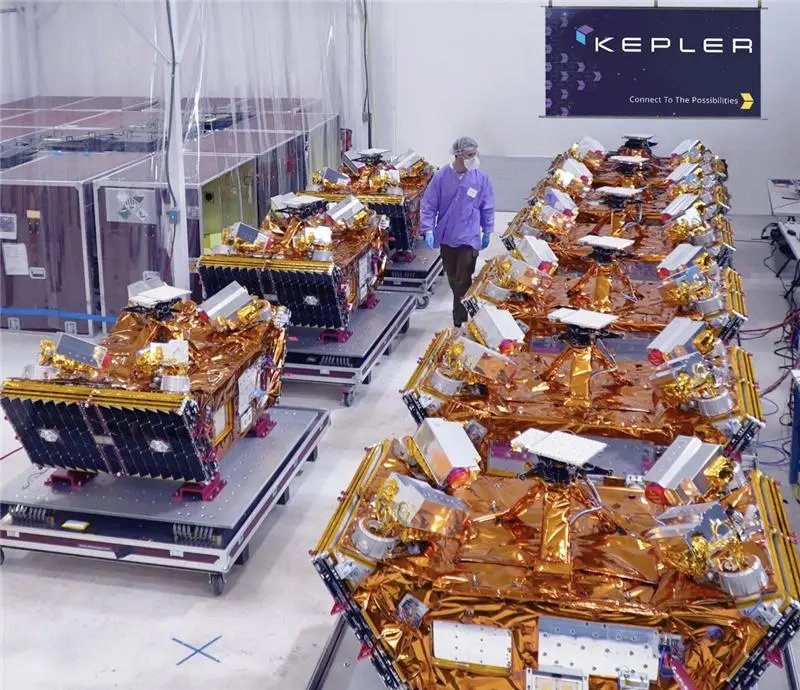
The Largest Orbital Compute Cluster Is Open for Business: A New Era of Space Computing
In a groundbreaking development for space exploration and technology, the largest orbital compute cluster has officially opened for business. This significant leap in computing capabilities from space authorities and private companies alike promises to revolutionize a myriad of fields—from satellite imagery analysis and global weather forecasting to advancements in artificial intelligence and machine learning.
What Is an Orbital Compute Cluster?
At its core, an orbital compute cluster consists of a network of interconnected satellites equipped with advanced onboard computing power. Unlike traditional computing systems that rely on terrestrial data centers, this cluster operates in low Earth orbit, enabling rapid data processing close to where it is collected. The advantage of this setup allows for low-latency communications and the ability to perform real-time analysis of vast amounts of data generated by Earth observation and other applications.
Capabilities and Features
-
Enhanced Data Processing:
The orbital compute cluster is designed to handle complex algorithms and process large datasets quickly. This is particularly beneficial for industries that depend on rapid data processing, such as meteorology, agriculture, and environmental monitoring. -
AI and Machine Learning Integration:
With the cluster’s high computational power, there is potential for significant advancements in AI and machine learning. Users can deploy algorithms on the cluster to analyze patterns in climate data, optimize supply chains, or even enhance disaster response strategies. -
Global Collaboration:
The open-access model promotes collaboration among researchers, institutions, and private companies worldwide. This democratization of space technology invites innovative projects and accelerates development in various sectors. -
Real-Time Analytics:
Leveraging real-time analytics enables organizations to make swift decisions based on current conditions, a feature crucial for emergency management and resource allocation during natural disasters.
Applications Across Industries
Environmental Monitoring
The compute cluster offers scientists and environmentalists unprecedented capabilities for monitoring climate change, deforestation, and wildlife migrations. By deploying algorithms to the cluster, researchers can analyze data collected from various sensors, satellite imagery, and ground stations to gain insights into ecological changes and trends.
Agriculture
Farmers are adopting precision agriculture techniques that require intricate data analysis for crop yield optimization. The compute cluster can analyze satellite imagery, weather patterns, and soil samples in real time, allowing farmers to make informed decisions on irrigation, fertilization, and pest control.
Urban Planning
City planners can harness the cluster’s power to simulate urban development scenarios, analyze traffic patterns, and assess the impact of new infrastructure. This capability leads to more sustainable and efficient urban environments.
Telecommunications
Telecom companies can benefit from real-time network optimization and predictive maintenance, improving service delivery while minimizing downtime and operational costs.
Future Prospects
As the largest orbital compute cluster begins its operations, the implications for space technology and various industries are vast. The availability of such computational power in space could pave the way for further technological advancements, potential applications in space exploration, commercial ventures, and even remote scientific research in extraterrestrial environments.
The successful deployment and operation of this cluster mark a new chapter in the intersection of space and technology. As scientists and engineers continue to innovate, we can expect to see the emergence of applications that were once confined to the realm of science fiction.
Conclusion
The opening of the largest orbital compute cluster signifies a monumental shift towards utilizing space as a platform for advanced computing. As the cluster becomes fully operational, it serves not only as a technological marvel but also as a catalyst for innovation across various sectors on Earth. Business leaders, researchers, and governments are now presented with endless possibilities to leverage this incredible resource, signaling a future where space and technology are more interconnected than ever before.
Leave a Reply